
How much an adult Maine Coon really weighs, what the ear tufts are for, how often to comb him and who this breed won't suit. No breed hype.
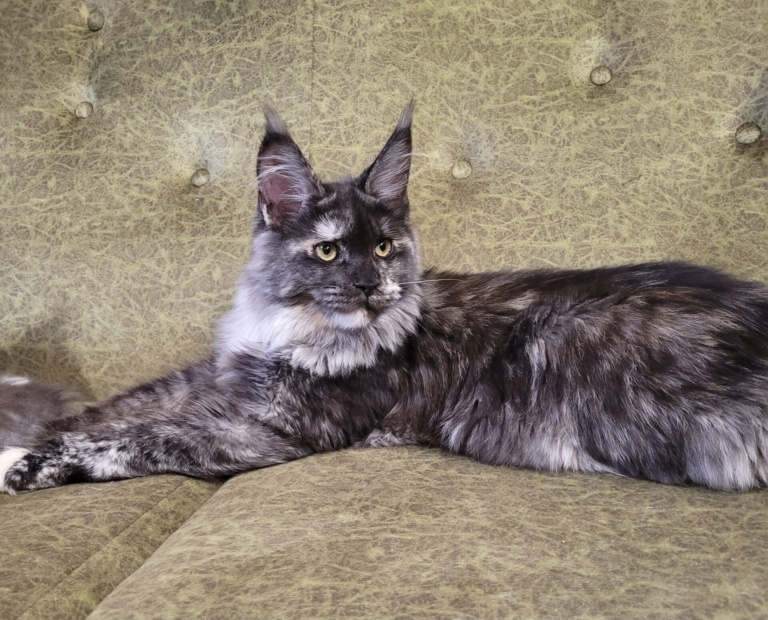
The question we hear most at shows is: "Is he going to get even bigger?" Usually yes, for another year or two at least. Almost every conversation about Maine Coons comes down to size, which is a shame: size isn't really why you live with one.
Nobody created the Maine Coon. The breed formed by itself on farms in the north-eastern United States, in Maine, which gave it its name. The selection was simple: the cats that survived the winter had dense coats, broad paws and a tail they could wrap around themselves while sleeping. Everything people love about the breed today started out as a way to survive in a cold barn.
Maine Coons were already appearing at American shows in the 1860s. Then the breed almost disappeared, pushed out by imported Persians, and breeders rebuilt it in the mid-20th century. Maine Coons reached Europe in the 1980s and Russia in the nineties.
An adult male weighs 6–9 kg, a female 4–6.5 kg. Some are bigger, but that isn't the norm and certainly not something to aim for.
The photos of "twenty-kilo" Maine Coons that do the rounds online almost always show either a clever angle with a front paw stretched towards the camera, or an obese cat. At twelve kilos a cat has aching joints and gets short of breath. It has nothing to do with breed quality.
They take a long time to grow. Their final weight and build arrive at about three, sometimes four. A one-year-old Maine Coon is still a teenager: long and gangly, with paws and ears he hasn't grown into yet. If someone offers you a kitten that's "already big", that tells you nothing about what he'll become.
A rectangular body, strong bones and a long tail that, on a good cat, reaches at least to the shoulder blades. A muzzle with high cheekbones and a firm chin, and a profile with a gentle curve. Large, high-set ears with tufts and furnishings (the tufts of hair growing from inside the ear).
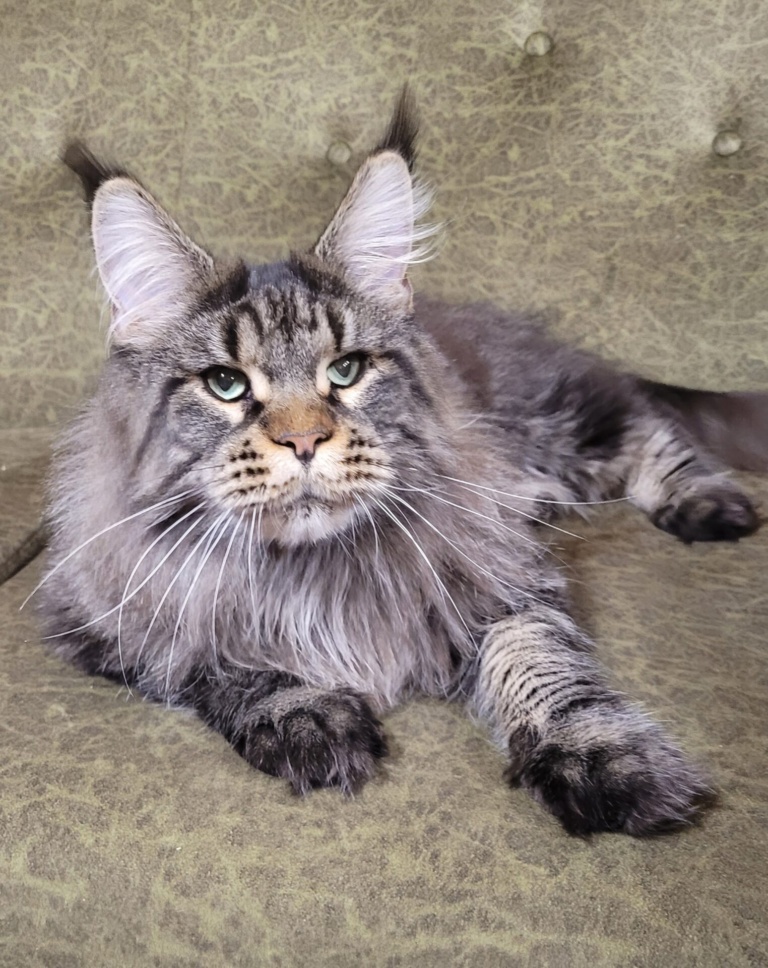
Ear tufts aren't compulsory. They can be magnificent or barely visible, and they make no difference at all to the cat's health. Kittens often have none, and they grow in by twelve to eighteen months.
The coat varies in length over the body: short on the shoulders, long on the sides, belly and "trousers". Around the neck there's a ruff, full in winter and almost gone in summer. Tufts of fur grow between the toes and make the paw look even bigger. On crusted winter snow, that paw really does work like a snowshoe.
Maine Coons are chatty but rarely miaow. Their usual sounds are chirps and trills, quite high-pitched for such a big animal. It surprises people at first: a nine-kilo beast walks in and makes a noise like a bird.
Everyone writes about the "dog-like cat", and there's some truth in it: a Maine Coon follows you from room to room, meets you at the door and comes to see what's going on in the bathroom. But there's no dog-like obedience in him. He's there with you and joins in; he doesn't take orders.
This is also the big disappointment for some owners. A Maine Coon isn't a lap cat. Many don't like being held, and they certainly won't sit on you for hours. A Maine Coon would rather lie half a metre away and watch. If you want a cat who sleeps on your chest, it's a lottery, and only a minority win it.
They get on easily with children and dogs, as long as the children don't drag the cat around by the tail and the dog knows its place. They also stay kittenish for a long time: a three-year-old still tears around after a sweet wrapper.
Less than people think, but not none. A Maine Coon's undercoat isn't as dense as a Persian's, and the coat doesn't felt into mats the first time you skip a session.
The routine that works: comb once a week, and every other day while he's shedding. You need a metal wide-toothed comb, plus a mat splitter just in case. I don't like slicker brushes: it's easy to rip out guard hairs with one and spoil the coat.
Mats always form in the same places: behind the ears, in the armpits and on the "trousers". Check those; the back usually looks after itself. A tight mat is better cut out: if you pull at it with a comb, the cat will remember the pain and won't let you near him next time.
A few more everyday things: trim the claws every two to three weeks and check the ears while you comb. The litter box needs to be big, because an adult Maine Coon physically doesn't fit in a standard one. Get a tall, heavy scratching post: he'll knock a light one over on day two.
A big, long-haired cat needs plenty of protein. With commercial food, look at the ingredients, not the word "premium" on the packet: meat should come first and be named specifically. With a natural diet, work out the ration properly instead of feeding him whatever is left from dinner.
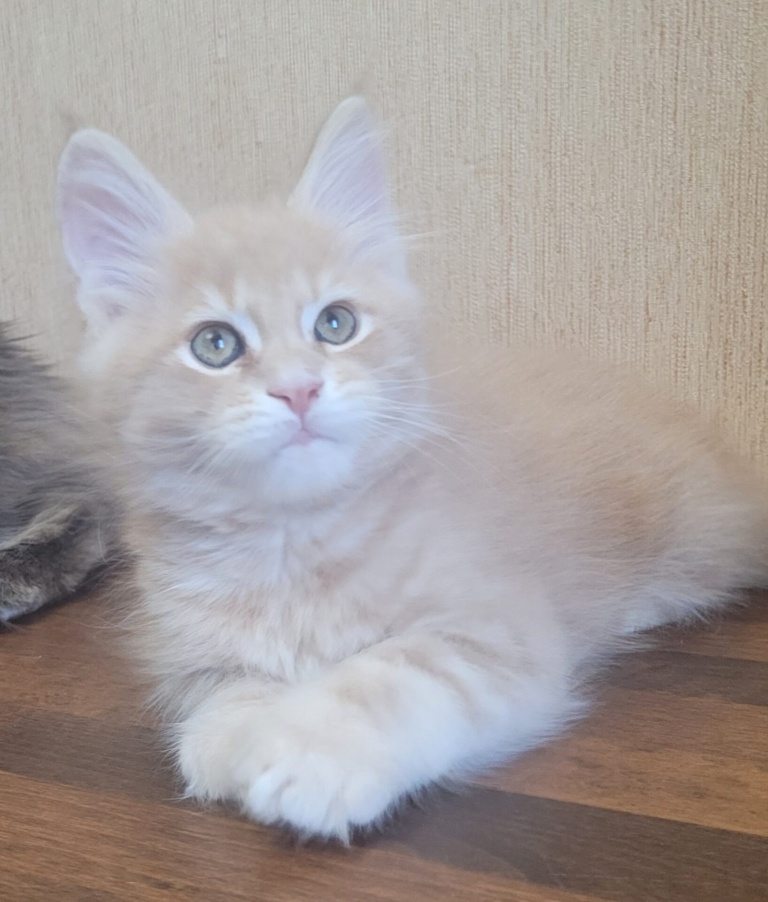
Weight after neutering is a topic of its own. The metabolism slows down, the appetite stays, and within six months a placid cat turns into a heavy one. Cut the portion straight after the operation, not once it starts to show.
Maine Coons love water: they play with it and climb up to drink from the tap. A water bowl next to the food often doesn't suit them, so put it somewhere separate, or better still buy a drinking fountain. The more your cat drinks, the less you need to worry about his kidneys.
The breed is robust, but there are hereditary diseases that breeding cats must be tested for:
When you choose a kitten, ask for the parents' test results: certificates with numbers, not a verbal "they're all healthy". A breeder who really does test will show them without being reminded. With sound breeding and a sensible weight, Maine Coons live 12–16 years.
If you want a small, quiet cat who sleeps on your lap and eats 40 grams a day, this isn't the breed for you. A Maine Coon takes up space. He's big, he follows you everywhere, and he knocks things off the table not out of malice but because his paw is big.
He also won't suit anyone who isn't ready for regular combing. Twenty minutes once a week isn't much, but it has to happen every week, not just when you remember.
If none of this has put you off, come and see the kittens in person. You can't choose a personality from photos, and two hours in a house where adult Maine Coons live will tell you more about the breed than any article.