How many times a day to feed a kitten and an adult cat, how to work out a portion from the target weight, what to change after neutering, and how to check body condition in ten seconds.
The feeding guide on the bag is worked out for an average cat. A Maine Coon is not an average cat: he's twice the size and grows for three times as long. An adult female on dry food needs about 60–80 grams a day, a male about 90–120, and over time that figure should come down.
Maine Coons eat little and often. It's a breed trait, and several small meals suit them better than two big ones.
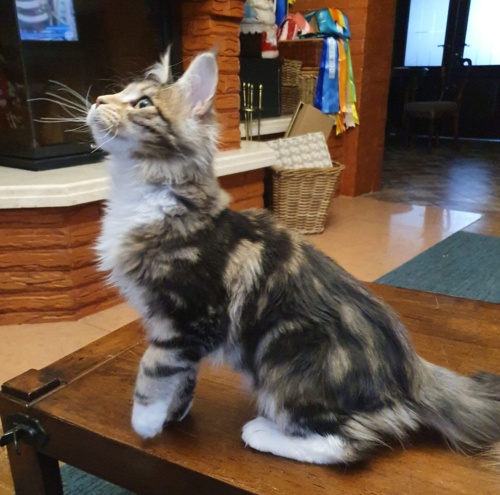
Up to 4 months a kitten is fed five or six times a day: its stomach is small and it grows fast. At 4–6 months it's four meals, from 6 to 12 months three, and a cat over a year old is fed two or three times a day.
Many people leave dry food out all day, and for a Maine Coon this works: he'll visit the bowl ten times a day and eat a little each time. There's one condition: measure out the daily amount in advance and don't top it up on demand.
Free feeding doesn't suit cats that tend to overeat, and some Maine Coons do. If your cat finishes the day's ration in two visits and asks for more, switch to set meals. Never leave wet food or raw meat out: they go off within a couple of hours.
You can start from the chart on the bag, but it only works with two adjustments.
Work from the target weight, the weight you want the cat to reach. If he's already overweight, feeding him by the chart for his current eleven kilos just locks the problem in.
The chart also assumes average activity. A young cat tearing round the flat and a neutered ten-year-old homebody may weigh the same but eat differently. The guideline is a starting point; after that you adjust the portion to the cat's condition.
As a rough guide for an adult Maine Coon on dry food: a 4.5–6 kg female needs about 60–80 grams a day, a 7–9 kg male about 90–120 grams. It's only a guide: foods vary a lot in calories, and the exact figure is always on the particular bag.
A natural diet is calculated differently: roughly 5% of body weight a day for a growing kitten and about 3% for an adult.
Weigh food on kitchen scales, not with a measuring cup. One person's "full cup" can differ from another's by up to a third, and an extra third every day is exactly the weight gain nobody can explain later. And the scales cost about as much as two bags of food.
Scales are useful, but condition matters more than the number: Maine Coons vary a lot in frame, and nine kilos looks different on a big-boned cat and on a smaller one.
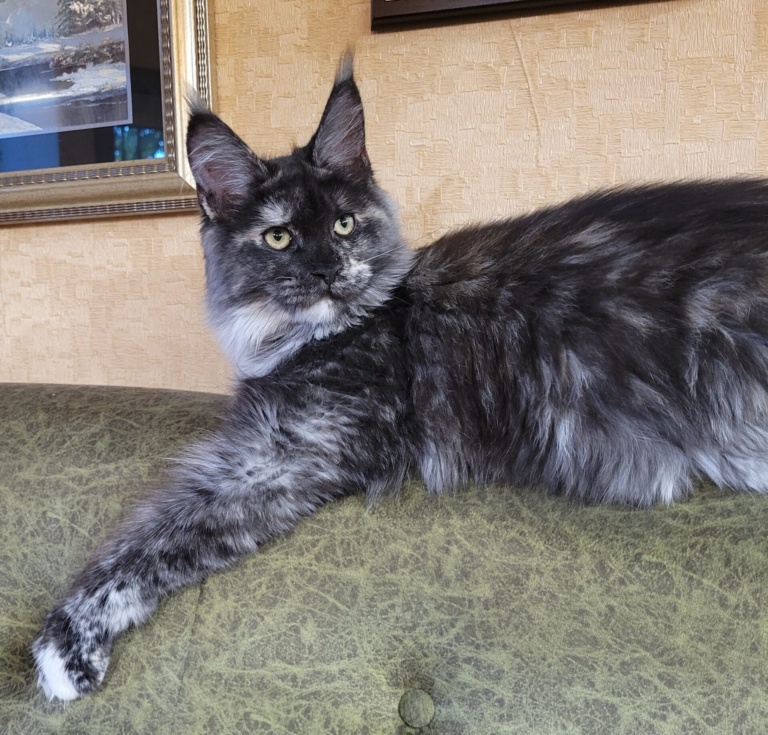
Run your palm along the cat's sides. You should be able to feel the ribs under the coat without pressing, but they shouldn't stick out. It should feel roughly like the knuckles on the back of your hand.
Look from above. There should be a visible waist behind the ribs. If from above the cat looks like a rectangle or a barrel, he's carrying extra weight. From the side, the belly line should rise from the chest towards the hind legs without sagging.
A small flap of skin hanging under the belly isn't fat: it's a normal anatomical fold, and most cats have one.
Weigh your cat once a month and write it down. Half a kilo up or down on a big cat is almost impossible to see by eye, but the scales show it straight away.
This is where most cats lose their shape. After the operation the metabolism slows by about a quarter, while the appetite stays the same or grows. Leave the portion as it was, and within six months a calm cat turns into a heavy one.
Cut the portion straight after the operation, without waiting for changes to show: by roughly 20–25%, then adjust to condition.
There are foods for neutered cats with fewer calories and more protein. Switching to one makes the job easier and helps preserve muscle.
If you're unsure of your numbers, write to the breeder you got the kitten from: they've seen how the littermates put on weight and can advise you based on the line. With that in hand, it makes sense to go to a vet for an exact calculation.
A Maine Coon kitten needs a lot of energy: it keeps growing until three, and the fastest growth comes in the first year.
There's no need to restrict a growing kitten's food. Up to a year old it eats as much as it wants, with no strict ration, and you keep an eye on its weight: the main sign that all is well is steady gain, not the exact number on the scales. If growth stops or the kitten is losing weight, write to the breeder first, and then, if that doesn't settle it, take the kitten to a vet.
The food should be a kitten food: it has more calories, more protein and a different mineral balance. Switch to adult food at around a year to eighteen months, depending on how much growth has slowed.
This gets mistaken for greed. If a cat eats his full ration and keeps asking for more, but is losing weight or not gaining any, it's not his personality. A sudden rise in appetite together with weight loss can be a sign of hyperthyroidism, diabetes or problems absorbing food.
It's normal for a well-fed cat to ask for seconds. It isn't normal if he's losing weight at the same time.
How to choose the food itself and what to look for in the ingredients is covered in a separate article. For growth month by month, see the Maine Coon growth chart.
Home in Raksi Maine Coon cattery, St Petersburg. You can see our kittens on the Kittens page, and ask feeding questions in our VK group (in Russian).