
How a girl differs from a male in size and behaviour, when heat cycles start, why pet females are spayed, and which families a female suits best.
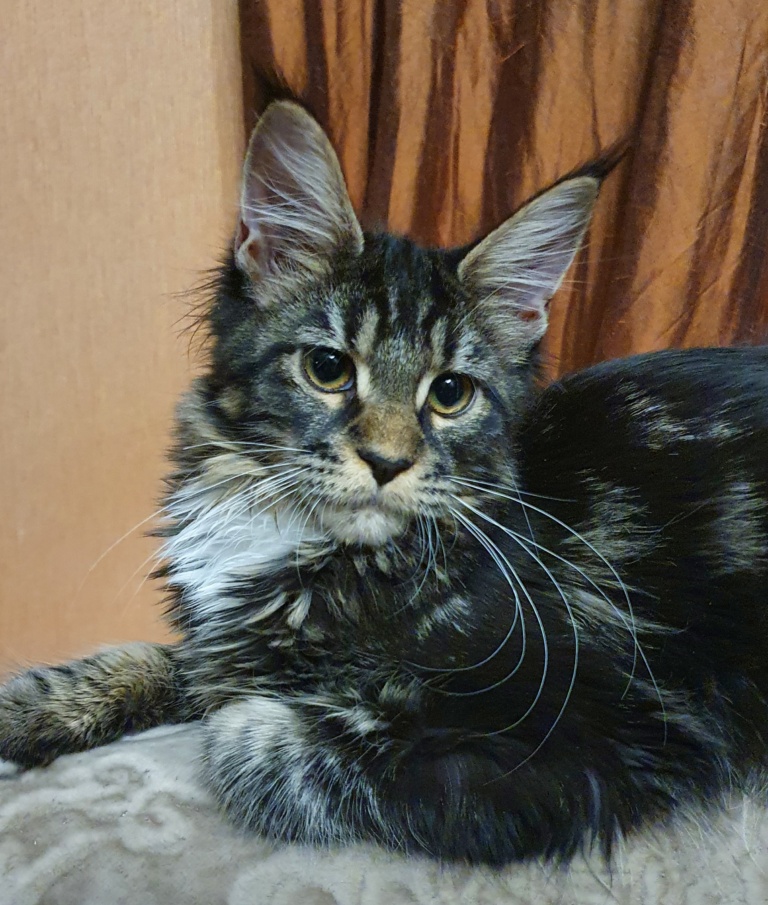
People usually choose a kitten's sex like this: "I want a bigger one", so they take a male; "I want a calmer one", so they take a female. Both ideas are only half right, and a Maine Coon girl doesn't suit every family that picks her for her calm.
An adult female weighs 4–6.5 kg, against 6–9 kg for a male. The difference is noticeable, but a Maine Coon female is still bigger than any ordinary house cat.
She's more delicately built: a lighter body, a neater head, a more modest ruff. The ear tufts and the "breeches" are all still there. Next to a male in photos the difference is obvious, but a female on her own is quite enough to amaze your guests.
She grows a little faster and finishes sooner, usually by two and a half, while males keep filling out until three or four.
Generalisations work less well here than we'd like, but there is one pattern. Females more often choose one person and stick close to them, while males tend to treat the whole family more evenly.
A female is usually more cautious with guests, takes longer to size people up and pokes her nose into other people's business less. Yet she's just as chatty, with the same trills and chirrups, and follows you from room to room just the same.
Around the house, females are tidier. A big male knocks things off the table not out of spite but because his paw is big. That happens less with a female.
This is the main difference from a male, and you need to know about it in advance. A Maine Coon's first heat comes late by cat standards, usually after eight to ten months. After that, heats come back every few weeks, with yowling and restlessness, and in some females with spraying too.
A pet female is spayed, and that condition is written into the pet-class contract. The owner's convenience isn't the only reason. Endless heats without mating lead to inflammation of the womb and mammary tumours, and spaying before the first heats sharply reduces the risk.
Discuss the timing with the breeder you got the kitten from: some catteries do early spaying themselves before the kitten leaves. If the operation is still ahead, first ask the breeder about the bloodline and how it copes with anaesthesia, then go to the vet to set a date.
A female is combed with a wide-toothed comb once a week, and more often when she's shedding. The problem areas are the same as in a male: behind the ears, in the armpits, on the "breeches". There's just less coat, and combing takes about fifteen minutes instead of twenty.
The difference between two females from different litters is almost always bigger than the difference between males and females in general. A breeder who has lived with the litter for three months will tell you more about a particular kitten's character than any article about sex.
Our females, with their tests and pedigrees, are on the Females page, and you'll find kittens on the Kittens page. We post litter news and photos of our grown-up kittens in our VK group (in Russian).
Home in Raksi Maine Coon cattery, St Petersburg.