
How much bigger males are than females, why males often turn out more affectionate, what to do about spraying and when to neuter a pet male.
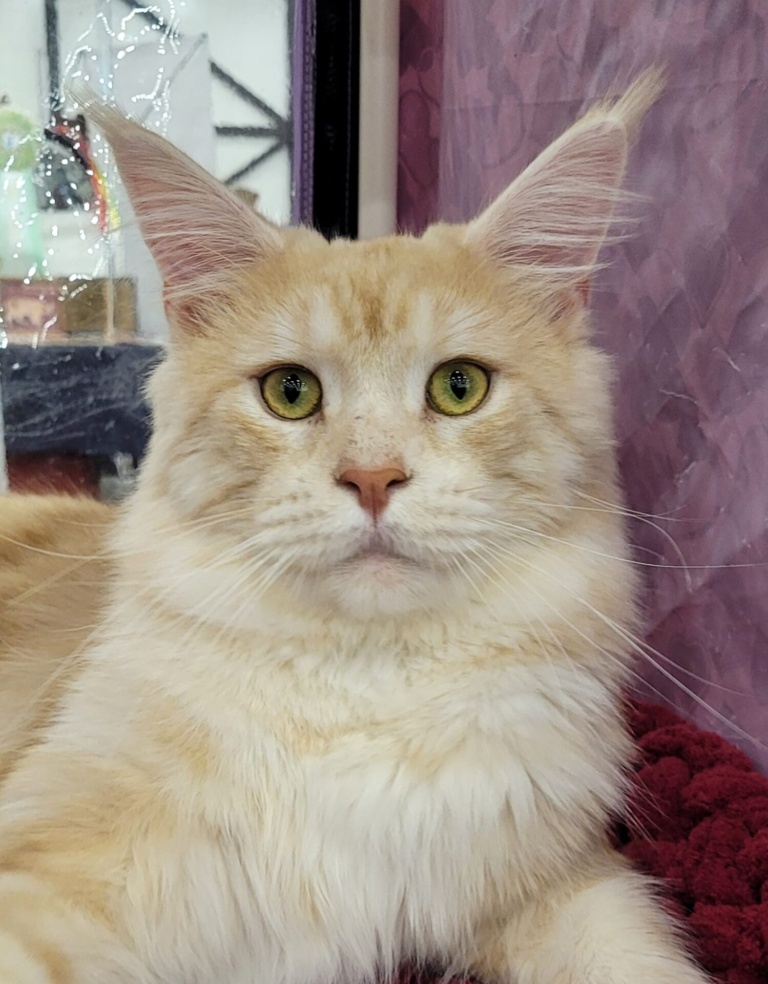
People come for a male more often than a female, and for one reason: he's bigger. They discover the other differences at home, usually in the first month, and there's more to them than an extra three kilos.
An adult male weighs 6–9 kg. His body is longer and heavier, his head bigger, his ruff more impressive in the winter coat, his paws wider.
He takes longer to mature than a female: he puts on most of his weight by one year, muscle and chest width by two, and reaches his final shape at around three or four. A one-year-old male looks like a gangly teenager, and that's normal.
Size has a side effect people don't think about in advance. An adult male needs a big litter box: he physically doesn't fit in a standard one. The scratching post needs to be tall and heavy, as he'll knock a light one over on day two. Check that shelves and bookcases are stable.
Here the pattern is the opposite of what people expect: Maine Coon males often turn out more affectionate and easier-going than females. They treat everyone in the family more evenly, accept guests more readily and are less territorial.
For all his size, a big male is gentle. He rarely uses his claws, walks away rather than fights and puts up with children for longer than he really should. He gets on easily with a dog in the house, especially if they met when he was a kitten.
He's just as chatty: chirrups, trills, remarks about a closed door. And he has the same habit of following his owner round the flat and lying down half a metre away. That doesn't make him a lap cat: a Coon prefers to be next to you rather than in your arms, whatever its sex.
An entire male starts marking his territory once he reaches sexual maturity. It isn't revenge or bad upbringing, it's instinct, and getting the smell out of a flat is hard.
A pet male is neutered, and the pet-class contract says so. As well as solving the spraying problem, neutering removes the risk of inflammation and tumours of the reproductive organs and makes the cat calmer.
Ask the breeder you got the kitten from about timing: they know the line, know how its relatives coped with anaesthesia and can tell you whether it's worth waiting. After that conversation, see the vet to set a date and find out how to prepare.
A note on weight after the operation: the metabolism slows down, but the appetite stays. Cut the portions straight away, or six months later you'll have a heavy cat instead of a big one.
A Maine Coon doesn't need a house in the country. He needs height and a place where nobody bothers him. A shelf above the wardrobe does more than an extra twenty square metres.
Our males, with their tests and pedigrees, are on the Males and Veterans pages. Kittens are on the Kittens page, and photos of our grown-up graduates are in our VK group (in Russian).
Home in Raksi Maine Coon cattery, St Petersburg.