
An ordinary litter box, a short scratching post, a water bowl next to the food and four more little things that later turn into puddles outside the box, a shredded sofa and a trip to the vet.
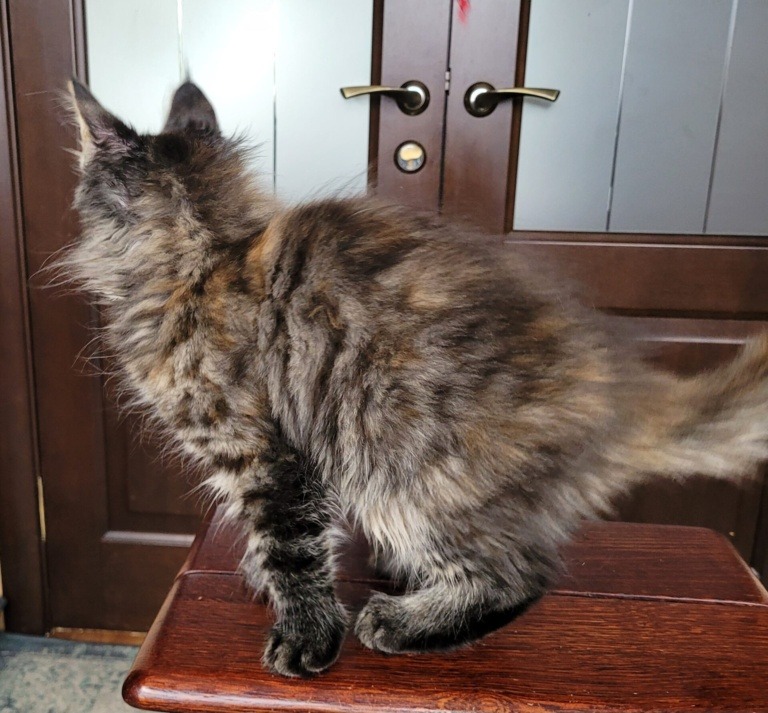
Most problems with a big cat start with the shopping, not with his character. You buy the wrong thing or put it in the wrong place, and six months later the cat seems to have "gone bad", when really it's his surroundings that have. These are the seven mistakes we most often talk through with buyers: an ordinary litter box, a short scratching post, a mosquito screen, water next to food, a sudden change of food, no place where the cat is left alone, and small things left within reach.
The litter box is the first thing people buy, and the thing they most often get wrong. They buy a standard 40 by 50 cm cat litter box, and six months later the cat physically doesn't fit in it and does his business with half of himself hanging over the edge.
The box should be about one and a half times the length of the cat's body from nose to the base of the tail. In an adult Coon that's 60–80 cm, so you need a box of at least 90 cm.
A cat needs room to turn round, to dig before and to cover up after. Without that room, he looks for alternatives and finds them in the bath, in a flowerpot or on your bed.
The sides should be at least 10 cm high, with a low entrance. Many Maine Coon owners use a plastic storage box instead of a cat litter box and cut an entrance in it: it's cheaper, and you can pick any size you like. You need one box per cat, plus one.
A cat sharpens his claws to shed the old outer sheath. It's a physical need: if not on a scratching post, then on the sofa.
A big cat will ignore a 60 cm post. He stands on his hind legs and stretches out to his full length, and in an adult Coon that's over a metre.
Stability is another weak point: nine kilograms will topple a light post by the second day, and after that the cat won't go near it again. Animals have a good memory for things that have fallen on them.
You need a scratching post at least a metre tall, with a heavy base or a wall fixing, covered in jute or sisal. Carpet covering wears out sooner and also teaches the cat to claw carpet in general. Put the post next to where the cat sleeps: cats stretch and sharpen their claws as soon as they wake up.
This is the most dangerous mistake on the list and the only one that can be irreversible.
An ordinary mosquito screen won't hold a cat. It sits on plastic corner clips, it's designed for mosquitoes, and it falls out together with the cat. This happens every spring, and a big cat's weight works against him here.
A cat-proof screen is built differently: a metal frame, strong mesh, screwed into place. It costs more than a mosquito screen and looks less elegant, but it has no other drawbacks.
The slight-tilt ventilation setting on a tilt-and-turn window isn't safe either: the cat squeezes into the angled gap, gets stuck where it narrows and is injured trying to get out.
Two bowls in one stand, the way pet shops sell them, don't suit a cat.
Cats don't drink where they eat. It's instinct: in the wild, water next to the remains of prey means dirty water. A bowl right beside the food puts the cat off, and he starts drinking less than he needs. For a neutered male this leads straight to urinary tract problems, and then the owner wonders where the urinary stones came from when the food was good.
Put the water somewhere separate, at least a metre from the food, or better still, put several bowls in different rooms. A drinking fountain works even better: cats trust running water more, and Coons drink from it more willingly.
Change the water twice a day and put something under the bowl: Coons paw at water and splash it all over the kitchen.
The kitten arrives, and waiting for him at home is a different food, one the owner picked in advance after reading the rankings.
Moving is stressful in itself: new smells, new people, none of his littermates. Add a change of diet, and an upset stomach is almost guaranteed.
For the first few weeks, feed the kitten what he ate at the breeder's. Ask in advance exactly what that is and buy it before he arrives.
It's best to switch food over a week and a half: three days of a quarter new to three quarters old, then half and half, then three quarters new, and only then the full switch.
If the new food gives him loose stools or he starts scratching, go back to the old food and write to the breeder, who knows how the littermates reacted. If the problem is still there after that, take the cat to the vet.
A cat needs a spot nobody else can physically reach: the top shelf of a bookcase, the top of a wardrobe, a tall cat tree. A bed on the floor is no substitute.
It gives the cat a way out of a situation. An animal with somewhere to go doesn't let things get as far as claws, while a cornered one defends itself. In a home with children or other pets, a place like this is a must.
Every main room needs some height. A shelf has to take nine kilograms without wobbling: a Coon doesn't hop up neatly, he lands. And a rule for the family: if the cat has gone up high, nobody goes after him.
Thread, hair ties, tinsel and Christmas tree icicles are dangerous because a cat can't spit out a thread she has started to swallow: her tongue is built so that it can only go further down. A linear foreign body in the gut means surgery.
Kittens chew cables while they're teething, so the cables go into cable covers.
Every part of lilies and related plants is deadly poisonous to cats, including pollen that lands on their fur. Other common plants that are dangerous include dieffenbachia, monstera and azalea.
Don't leave household chemicals and medicines in cupboards that aren't locked: a cat opens doors with his paw better than you'd expect.
A laser pointer is a danger to the mind rather than the body: a hunt that never ends in a catch leads to obsessive behaviour in some cats.
None of these mistakes looks like a mistake when you make it: the problem shows up months later, when you can no longer see the link to the cause. And almost all of them can be avoided while you're still shopping.
For the kitten's first days with you, see The first days at home.
Home in Raksi Maine Coon cattery, St Petersburg. You can see our kittens on the Kittens page, and everyday questions are welcome in our VK group (in Russian).
 What to buy before your Maine Coon kitten arrives: a no-nonsense list18 October 2026
 Litter box and litter for a Maine Coon: what size you need and what to do if the cat misses11 October 2026