
Why a standard litter box is physically too small for a big cat, open or covered, which litter to choose and what a puddle on the bed means.
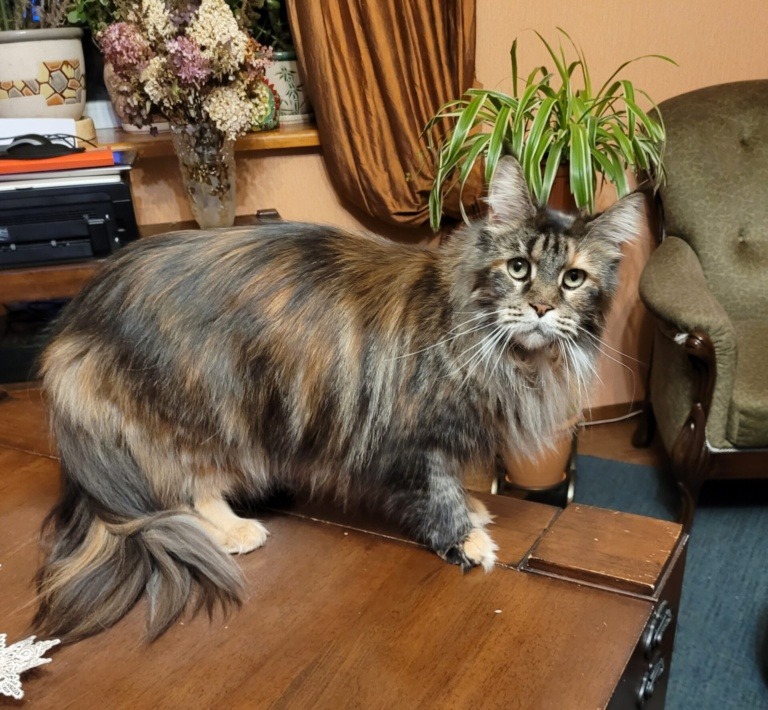
This is the first purchase almost every Maine Coon owner gets wrong. They buy an ordinary litter box from the pet shop, and six months later find the cat no longer fits in it and does his business with half his body hanging over the edge.
What a big cat needs, and why half of all toilet problems are solved by changing the box.
The rule is simple and works for any cat: the box should be about one and a half times the length of the cat's body, measured from the nose to the base of the tail.
An adult Coon's body is 60–80 cm long. So the box needs to be at least 90–100 cm long. A standard cat litter box is 40–50 cm, half what's needed.
A cat needs room to turn round, dig beforehand and cover up afterwards. If he can't, he starts looking for alternatives and finds them in the bath, in a flowerpot or on your bed.
The sides should be at least 10 cm high: Coons dig with enthusiasm and fling litter a long way. The entrance should still be low or have a step, especially if you have a kitten or an older cat with sore joints.
Many Maine Coon owners skip the cat litter box altogether, buy a plastic storage box of the right size and cut an entrance in it. It's cheaper, and you can get any size you like.
And the number: one box per cat, plus one. Even with a single cat, a second box in another room heads off some problems.
Open. The most comfortable for the cat: he can see what's going on around him and doesn't feel trapped. The downsides are the smell and scattered litter.
Covered (hooded). Convenient for people: less smell in the room, and the litter stays inside. But it needs to be big, and there aren't many big covered boxes. Some cats won't use them either: the smell builds up inside, and there's only one way out, which to an animal means a possible trap.
High sides with a low entrance. The compromise, and what works best for a Coon: the litter stays inside, but the cat doesn't feel shut in.
If your cat suddenly stops using a covered box, take the lid off for a week. That solves the problem more often than you'd think.
Clumping clay is the most popular. It controls smell well, is easy to clean and most cats accept it. The downside: it's dusty, and some of the dust settles in the long fur of the "trousers" on the back legs. Look for coarse-grained kinds labelled low-dust.
Wood pellets. Cheap, eco-friendly and low in dust. When wet, the pellets break down into sawdust that the cat tracks around the flat. They control smell less well than clay.
Silica gel. Excellent at absorbing smell, so it needs changing less often. It's expensive and crunches loudly underfoot, and some cats can't stand the sound. The sharp crystals can also be unpleasant on the paws.
Corn and paper. Soft on the paws, and suitable for kittens and for cats after surgery, when ordinary litter could get into the stitches. More expensive, with average smell control.
Cats are creatures of habit. If your cat is happy with his litter, don't change it to save money. If you have to change it, do it gradually, mixing the new litter into the old over a week.
Because of the tufts of fur between their toes, Maine Coons track litter around more than shorthaired cats do. A mat in front of the box helps, and so does trimming the fur on the paws every couple of months.
Away from the food and water bowls: a cat won't eat where it goes to the toilet. That's basic instinct.
In a quiet place without constant comings and goings or noise. A washing machine that suddenly starts its spin cycle will put a cat off that corner reliably and for good. Not in a busy hallway, and not where children or the dog run about: the cat needs a clear way out, not a dead end.
In a large flat or a home on two floors, put a box on each floor.
A kitten from a cattery arrives already litter trained: his mother taught him, and that's one of the reasons kittens don't leave before three months.
Your job is not to undo that. For the first few days, keep the kitten in one room with the box so he always knows where it is. Use the same litter the breeder used: ask which one in advance.
After he sleeps and after he eats, carry the kitten to the box. Praise him when he goes. Scolding him for an accident is useless and does harm: a cat doesn't link the punishment to what it did, it links it to you.
There are two different situations, and each is dealt with differently.
Puddles and poos outside the box usually mean a protest about conditions or a health problem. Go through the list: is the box clean? Big enough? Has the litter been changed? Has the box been moved? Is there a new animal or person in the house?
Spraying looks different: the cat stands with his tail upright and quivering, and aims the spray at a vertical surface. This is territorial behaviour, not toileting. In entire males it's instinct, and neutering solves it.
One separate and urgent point. If the cat strains in the box with nothing coming out, goes little and often, cries when urinating or there's blood in the urine, it may be a urinary blockage. In males this is an emergency where hours count: take him to the vet immediately.
In all other cases, the usual order applies: first message the breeder you got the kitten from. They know the habits of the line and can often guess the cause from a couple of questions. If things are still unclear after that, go to the vet to rule out cystitis and urinary stones.
And on cleaning up: don't use bleach or ammonia on the spot. To a cat, ammonia smells like urine, and he'll come back to the same place. You need an enzyme cleaner that breaks down organic matter.
A good many stories of "the cat does it out of spite" end with swapping the box for one twice the size. Cats do nothing out of spite: they simply use what's comfortable and avoid what isn't.
What else to buy before the kitten arrives is covered separately. Our advice on looking after a cat is in the Care guide, and the first days at home are described in The first days at home.
Home in Raksi Maine Coon cattery, St Petersburg. Our kittens are on the Kittens page, and you can ask everyday questions in our VK group (in Russian).
 7 Maine Coon care mistakes that seem harmless23 October 2026
 What to buy before your Maine Coon kitten arrives: a no-nonsense list18 October 2026