
Why a big cat is safer than a small one, what to explain to your child before the kitten arrives, how to give the cat a refuge, and how young is too young for the children.
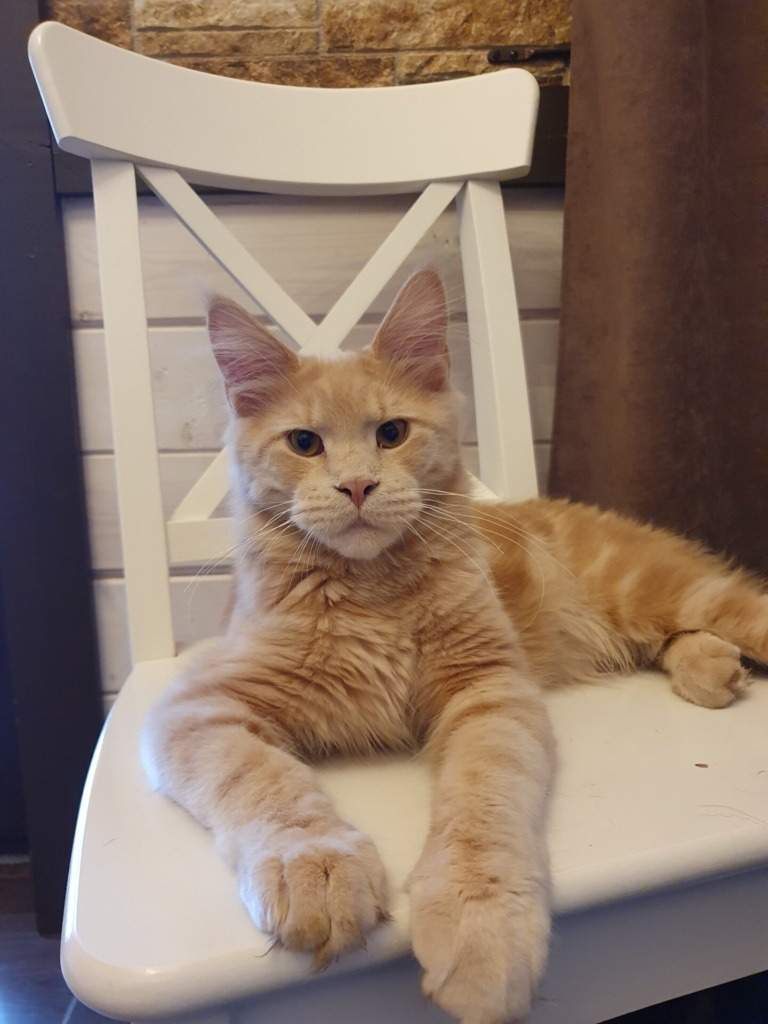
"We have two children, can we cope with a Maine Coon?" We hear this more than any other question, except the one about size.
Usually we say yes. But there are a few conditions, and without them even the most patient breed reaches its limit.
A small cat that's handled carelessly feels defenceless and defends itself straight away: claws, teeth, hissing. For a big animal it's quicker to walk away than to fight, and a Maine Coon almost always walks away.
The breed is also even-tempered. Maine Coons are slow to anger and quick to forgive, rarely use their claws and almost never swipe in earnest. They put up with more than they should, and in a house where the cat may be hugged without warning, that's exactly what you want.
A Maine Coon won't hide from the bustle of family life. He comes over to see what the children are building with their blocks and lies down beside them while they do their homework.
But patience isn't endless, and you can't treat it as a safety net.
It's best to have the talk beforehand: once the kitten has arrived, nobody's in the mood for rules.
The most important rule: leave a sleeping cat alone. An animal that's woken up reacts by reflex, and most bites happen just after waking.
Don't carry the cat around unless he asks to be picked up. A Maine Coon weighs as much as a big dog of a small breed, and a child physically can't hold him: they'll drop him, get a fright and end up with scratched arms. It's better to stroke him on the floor or on the sofa.
No pulling the tail, ears or paws. A Maine Coon's tail is long and just begs to be grabbed, so mention it specifically. Don't touch the cat while he's eating or in the litter box either: even a calm animal guards its food and its toilet.
A cat shows when he's had enough: he walks off, twitches his tail, flattens his ears. Teach an older child to read these signals and it will never come to a conflict.
A cat needs a place nobody else goes. His own mat isn't enough; he needs a spot the child physically can't reach: the top shelf of a bookcase, a wardrobe, a tall cat tree.
Nobody is suggesting you shut the cat away: he just needs a way out of the situation. If he has somewhere to go, it never comes to claws, whereas a cat that's literally backed into a corner will defend himself.
A shelf for a big cat has to take nine kilos without wobbling. Check the fixings: a Maine Coon lands on it with his full weight.
Put the litter box somewhere the child doesn't wander into, too. A cat who is disturbed in the litter box starts looking for other places, and sorting that out takes a long time.
The younger the child, the harder it is, and that's not down to the cat. Under three, a child can't physically control how hard they grab and doesn't understand that the animal is in pain. It's better not to get a kitten at this age, and the one at risk is the kitten, not the child: a three-month-old Maine Coon weighs two kilos and is easily hurt.
From four or five, children can learn the rules if they're repeated regularly, and at this age you can get a kitten. School-age children are easiest of all: the child can help look after the cat, and a Maine Coon readily accepts children as members of the pack in their own right and often picks a child as his person.
Sometimes it's the other way round: the Maine Coon is already at home and the baby has only just arrived. The breed takes this calmly. Give the cat access to every room except the nursery, don't change his routine abruptly, and don't chase him out of the places where he used to sleep.
The Maine Coon is not a hypoallergenic breed; no such breed exists. The reaction is caused by a protein in saliva and dander, and coat length makes no difference. A big cat simply has more of that protein.
Test it on real cats, not with random lab tests. The easiest way is to go to a cat show and spend three hours in a hall with a hundred cats. If there's no reaction even there, that's a good sign, though symptoms sometimes only appear after several days of constant contact.
Giving back a kitten who has already settled into a family is hard on everyone, and hardest of all on the child.
An animal in the house shows a child that another creature has its own boundaries and that you respect them, even when you're dying to give it a squeeze. That's more convincing than any explanation, because the cat himself responds, and straight away.
You can see what this looks like in our graduates' families on the Reviews page, and our kittens are on the Kittens page.
Home in Raksi Maine Coon cattery, St Petersburg. Ask us in our VK group (in Russian): we'll tell you all about life with children, as our graduates have that experience.
 7 Maine Coon care mistakes that seem harmless23 October 2026
 What to buy before your Maine Coon kitten arrives: a no-nonsense list18 October 2026
 Litter box and litter for a Maine Coon: what size you need and what to do if the cat misses11 October 2026