
How to introduce your cat to a newcomer properly, why you shouldn't put them nose to nose on the first day, how long settling in takes, and which animals a Maine Coon shouldn't live with at all.
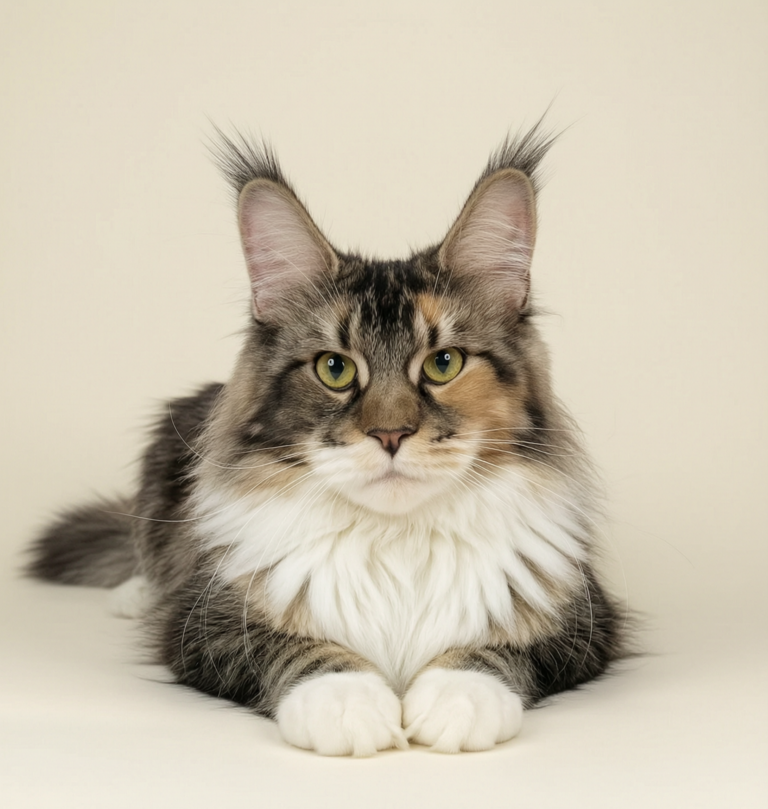
The Maine Coon is said to be one of the easiest breeds to keep with other animals, and that's close to the truth. But most conflicts between pets come not from their personalities but from the way they were introduced in the first few days. Below is a sequence that works almost every time, and the cases where it won't help.
There are three reasons, and they're all about temperament.
A Coon is slow to get worked up. He doesn't go for a newcomer straight away; first he watches for a long time from up high, and that time works in your favour.
A Coon walks away instead of fighting. A big animal doesn't need to prove he's in charge with his claws. It's easier for him to take a higher shelf and wait.
A Coon is curious. A newcomer is an event first and only then a threat. Add his late maturity: a three-year-old Coon is still keen to play, and playing together brings animals closer faster than anything else.
The main mistake is to bring the newcomer in and put the animals nose to nose. That sets up a conflict that then takes months to untangle.
The new animal goes into a separate room with everything it needs: bowls, water, a litter box, a bed, a hiding place. The door stays shut. The resident pet stays in his own territory.
At this stage they get used to each other's smell and sounds without meeting. It usually takes three to seven days. Swapping scents speeds things up: switch their beds round or rub them both with the same towel.
Open the door slightly and wedge it so there's a gap, or put a gate across the doorway. The animals can see each other and can move away at any moment.
Feed them on either side of the barrier. Food creates a strong positive association, and the other animal's presence starts to mean something pleasant.
Hissing at this stage is quite normal. It's not aggression but a warning: the animal is keeping its distance with its voice rather than its claws.
Arrange it once both of them are eating calmly on either side of the door and have stopped freezing at the sight of each other.
The meeting should be short, with you there, in a large room with places to retreat to and to climb onto. End it before anyone gets nervous, not after. It's best to trim both animals' claws beforehand.
Anything from two weeks to a couple of months. Faster with kittens, slower with adults. They may never become friends, and that's a normal outcome: a calm truce works too.
It works best with animals of the opposite sex and similar temperament. Two adult entire males in one territory is the combination most likely to end in conflict.
Don't make them share resources: you need one litter box per cat plus one, and a bowl and a bed for each animal, placed in different spots. More than half of all conflicts between cats are about resources, not about who likes whom.
Height solves a lot. Shelves and cat trees add usable space to a flat and let the cats keep out of each other's way.
Coons get on with dogs readily, and a cat and a dog often end up closer than two cats.
The conditions are simple. The dog must know basic commands and must not have a strong hunting instinct towards small animals. The first meetings happen with the dog on a lead, step by step, as described above. The cat must have a way up to somewhere the dog can't follow.
A word about food: the bowls go in separate places, ideally at different heights, with the cat's higher up. And the litter box goes where the dog can't get to it, or you'll have the trouble every dog owner knows about.
A puppy and a kitten who grow up together usually become inseparable, and that's the easiest scenario of all.
To be honest here: the Maine Coon is a hunter, and the breed was shaped by catching rodents in barns.
He sees rodents, birds and fish as prey, not as housemates. Instinct can't be trained away: it either kicks in or it doesn't, and testing it on a live hamster isn't a good idea.
Only one solution works: physical separation. A cage out of reach, a closed lid on the aquarium, a separate room with the door shut. Never leave them together unsupervised, even if the cat has shown no interest for years.
Take action if the cat has stopped eating, started going outside the litter box, hides all day, has lost weight or has become aggressive towards people.
This is exactly how the stress of a new arrival shows, and it can be strong enough to have physical effects. First write to the breeder you got your kitten from, who knows the character of the bloodline and the usual ways cats settle in. If things don't improve after you've talked, or there are physical symptoms, go to the vet.
A common idea: Coons don't cope well with being alone, so get him a companion. Sometimes it works, but you can't count on it as a solution.
A Coon needs a person, not just any living creature in the flat. A second cat helps pass the day, but doesn't replace the one he comes to the door to greet.
Owners of our kittens describe how they live with other pets on our Reviews page. Our Maine Coon kittens are on the Kittens page.
Home in Raksi Maine Coon cattery, St Petersburg. Questions about bringing in a new pet are welcome in our VK group (in Russian).
 7 Maine Coon care mistakes that seem harmless23 October 2026
 What to buy before your Maine Coon kitten arrives: a no-nonsense list18 October 2026
 Litter box and litter for a Maine Coon: what size you need and what to do if the cat misses11 October 2026