
The four places where mats always form, why you mustn't comb them out, why a mat splitter beats scissors and which tool ruins the coat for months.
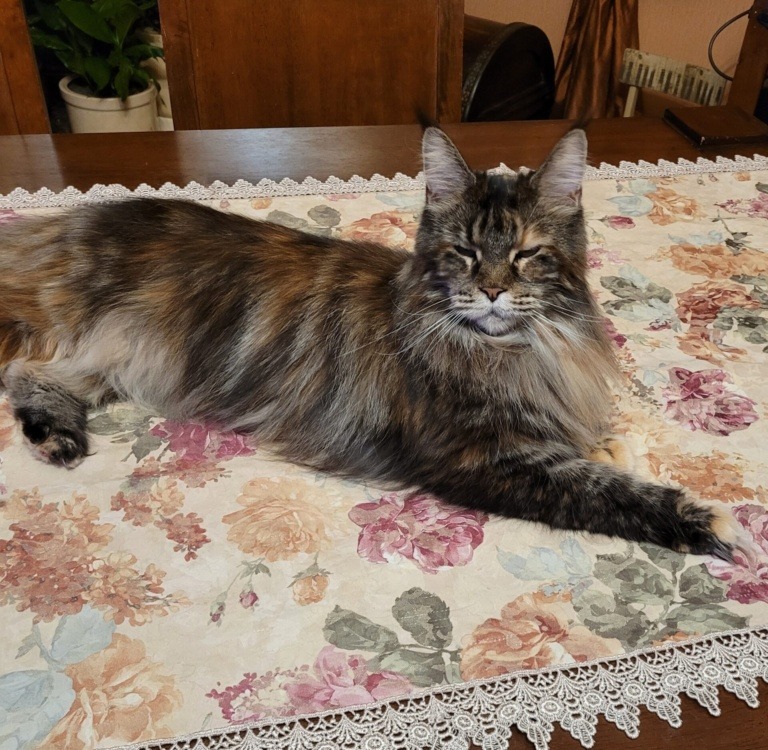
A mat isn't dirt or a sign of neglect. It's undercoat that has stopped falling out and started twisting around the guard hairs, felting into a tight knot.
In a Maine Coon, mats always appear in the same places, and if you go over them regularly with a metal comb, twenty minutes a week is enough.
There are only four zones, and the back isn't one of them: the fur there is shorter and the cat grooms it himself. Mats most often appear behind the ears, where the fur is fine and soft and the cat is constantly rubbing his head against the furniture and against you.
In the armpits and groin the fur is long, it rubs all the time as he moves, and the cat can't reach it himself. The "trousers" and inner thighs grow the longest fur on the body. That leaves the area under and around the tail, where the fur also gets dirty.
Check exactly these places. The owner sees a beautiful back and thinks all is well, while there's already a knot in the armpit.
The main cause is irregular combing. Shed undercoat doesn't leave the coat by itself: it stays between the guard hairs and gradually felts.
A Maine Coon's coat is forgiving: the undercoat isn't as dense as a Persian's, and one missed session changes nothing. Three months without a comb, though, turn the cat into a job for a groomer.
Mats form faster during the shedding seasons in spring and autumn, when several times more undercoat comes out than usual. Wet fur also felts faster, so after a bath the cat must be dried completely and combed.
Excess weight plays a part too: a fat cat physically can't reach parts of his body when he grooms. And on a poor diet the coat loses its structure and starts matting for no obvious reason.
Older cats don't groom themselves as well. But if mats suddenly appear on a cat who used to keep himself tidy, take note: the cause may be joint pain or a problem in the mouth.
Out of everything the pet shop sells, you need two things. Most of the work is done by a metal wide-toothed comb: it goes through the full length of the coat, separates the strands and pulls out shed undercoat. Choose one with long teeth and rounded tips.
You'll rarely need a mat splitter, but in a difficult case you can't do without one. Its hook-shaped blades cut the knot from the inside without touching the skin.
We don't recommend a slicker brush with its dense, fine wire pins: it's easy to rip out guard hairs with it, they take months to grow back, and fluffy down sticks up where they were. For a Maine Coon, whose coat is valued precisely for its texture, that's a bad trade.
The same goes for a FURminator, only more so: it cuts the guard hairs along with the undercoat. It suits short-haired cats, but not long-haired ones with prominent guard hairs.
Comb the cat once a week, and every other day while he's shedding: first the whole cat, combing in the direction the fur grows, then the four problem zones separately, holding the skin at the base with your hand so you don't pull.
Never comb out a mat. Pulling at a felted knot with a comb hurts, because the skin underneath stretches along with the fur. The cat will remember the pain and won't let you near him next time, and you'll be combing him for the rest of his life.
A small, loose mat you can try to tease apart with your fingers. Holding the fur at the base, separate the knot into strands, working from the edge towards the centre. A detangling spray or a little talc helps.
A dense mat comes out with a mat splitter. Work the hooks into the knot, cut it into pieces along the direction of growth, and comb out what's left.
A large felted patch will have to be cut out. Doing it with scissors is risky: a cat's skin is thin and loose, it's easy to catch it under the mat and cut it, and such cuts are far from rare. If you do decide to, slide a comb between the skin and the knot and cut above the comb.
When the coat has felted into a solid pelt, it's a job for a groomer. The cat is clipped, sometimes under sedation, because it takes a long time. Better not to let it get that far: under a continuous mat the skin gets sore and damp, inflammation sets in and parasites move in.
If lots of mats appear suddenly, first message the breeder you got the kitten from: they know what kind of coat runs in the line and whether it could be down to diet. If the cause is still unclear after that, take the cat to the vet: a sudden decline in the coat can be a symptom.
Start when he's a kitten, and start with touch rather than combing. Stroke the kitten where you'll later be combing: behind the ears, in the armpits, on the "trousers". Then bring in the comb: a couple of strokes along the back, where it feels nice, and let him go straight away.
Five minutes every day works better than half an hour of wrestling once a week. Stop before the cat gets fed up. And never hold him down by force: one time like that sets the training back by months.
An adult cat who has never been combed is trained the same way; it just takes longer.
We cover coat care in full in our grooming article, and general care advice is collected in the Care guide.
Home in Raksi Maine Coon cattery, St Petersburg. You can see our kittens on the Kittens page, and we post care guides in our VK group (in Russian).
 Maine Coon ears: shape, tufts, furnishings and how to care for them6 October 2026
 Maine Coon grooming: coat, claws, ears and paws26 September 2026
 Maine Coon shedding: 5 myths and 7 reasons it suddenly gets worse9 September 2026