
Why an indoor cat sheds all year round, whether bathing helps, what to do about hair in the house, and when heavy shedding stops being seasonal and becomes a symptom.
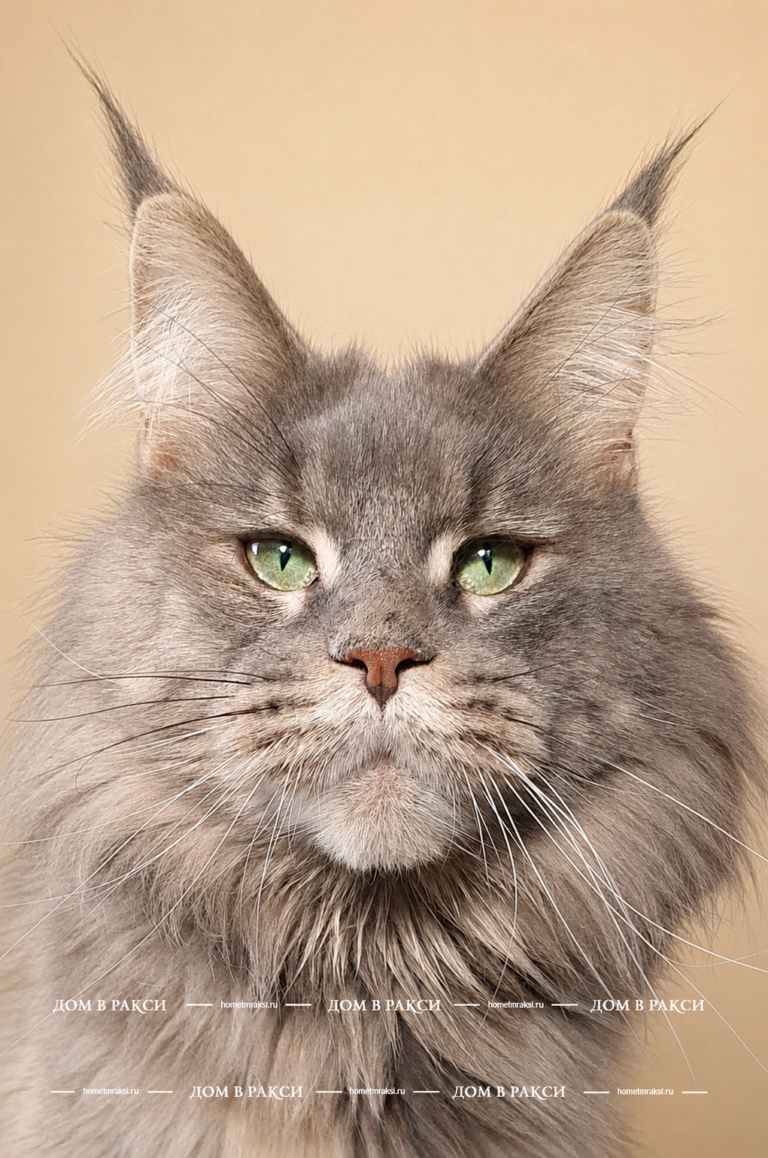
Come spring, a Maine Coon owner finds the cat apparently falling apart: fur comes away in clumps, one pass of the comb pulls out a handful of undercoat, and there's fluff all over the sofa.
For a cat living outdoors, yes. The coat change is triggered by changing day length: in spring the undercoat is shed, and in autumn the winter coat grows in.
An indoor cat lives at a steady temperature under artificial light, which blurs the signal. Shedding spreads across the whole year: a little all the time, more in spring and autumn. So if your cat sheds constantly, nothing is wrong; that's simply what life in a flat does.
Half true. A bath during a moult does wash out some of the loose undercoat, and people make use of this before a show.
As a regular habit, though, it works against you: frequent washing strips the protective oils, the skin responds by producing more sebum, and the coat gets dirty faster. A pet cat is bathed two or three times a year. What helps during a moult is not washing but combing more often.
There'll be no long hair, but there'll be short hair instead. The undercoat keeps falling out, only now in short bits that are harder to comb out and work deeper into fabric.
There's also a risk people are rarely warned about: in some cats the guard hairs grow back thinner after clipping and lose their water-repellent quality, sometimes for years.
Not on its own. A longhaired cat has a lot of coat, so the seasonal change looks dramatic simply because of the quantity.
Go by the state of the coat, not by how much hair ends up on the comb: no skin showing through, no bald patches, no scratching, and the cat behaving as usual. If that's the case, it's just shedding.
On a complete diet, vitamins aren't needed unless a vet prescribes them, and some of them, especially the fat-soluble ones, are harmful in excess.
If the coat is poor, the cause is usually the diet as a whole, not a missing supplement. Meat as the first ingredient, at least 32% protein, enough water.
The most common cause and the most harmless. The radiators go on, the flat becomes warm and dry, and the body gets the signal to drop its undercoat. The same happens when you move to a different climate.
A sudden moult within a day of a move, a vet visit or a new animal arriving is common. It's caused by a surge of stress hormones that pushes many hairs into the shedding phase at once. This kind of shedding stops by itself once things settle down.
A shortage of protein and certain amino acids shows in the coat first: it turns dull and dry, starts to mat and sheds out of season. A sudden change of food belongs here too: switch foods gradually, over a week and a half.
Fleas, mites, and less often fungal infections. The signs: the cat scratches or licks one spot, and there's dandruff, scabs or redness on the skin. Indoor cats get them too; fleas come in on shoes.
To food or to something in the house. It shows up as itching, scratch marks and bald patches, often on the face, neck and belly.
Thyroid problems in older cats, less often adrenal problems. Here the hair loss is symmetrical on both sides of the body, the coat thins evenly, and there are often changes in appetite, weight and thirst as well.
This isn't shedding but something that looks like it: the cat pulls out its own fur to relieve anxiety. You can tell by the pattern. The fur looks as if it has been trimmed, the skin underneath is clean, and the areas affected are usually the belly, the inner thighs and the base of the tail.
Reasons to look into it: bald patches, especially symmetrical ones; dandruff or scabs at the roots; red skin; the cat licking or scratching one spot; shedding out of season that doesn't stop; a coat that turns dull or changes texture; changes in appetite, weight or thirst along with the shedding.
First, write to the breeder you got the kitten from: they know what kind of coat the line has, what the littermates looked like at this age and what the kitten was fed at the cattery. Some questions can be settled with a message and a photo.
If things are still unclear after that, or there are bald patches and itching, you need a vet. They usually start by examining the skin and ruling out parasites, and go from there.
The main thing here is combing: a metal comb with widely spaced teeth, every other day during a moult. Go through the full length of the coat and give extra attention to four problem areas: behind the ears, the armpits, the britches and under the tail.
I don't recommend a FURminator or a slicker brush for a Maine Coon: they cut and pull out the guard hairs along with the undercoat, and the coat loses its structure.
Dry air from the radiators makes shedding and static worse, and a humidifier noticeably cuts the amount of hair floating around. The same logic applies to drinking: dehydrated skin produces a dry coat that breaks and sheds more. Put the water away from the food, at least a metre away.
And a word on hairballs. A longhaired cat swallows a lot of fur when it grooms itself, and regular combing deals with this more reliably than any paste: you simply remove the hair before it reaches the stomach.
The coat people choose the breed for doesn't vanish twice a year. There's so much of it because the Maine Coon developed in snowy Maine, where the cats that survived were the ones with a dense undercoat. Twenty minutes with a comb each week, and an hour during a moult, is the price you pay.
Mats, grooming and coat myths are covered in detail in separate articles, and our advice on day-to-day care is collected in the Care guide.
Home in Raksi Maine Coon cattery, St Petersburg. You can see our kittens on the Kittens page, and you're welcome to ask grooming questions in our VK group (in Russian).
 Mats in a Maine Coon's coat: why they form, how to remove them and what to comb with16 October 2026
 Maine Coon ears: shape, tufts, furnishings and how to care for them6 October 2026
 Maine Coon grooming: coat, claws, ears and paws26 September 2026