
Why a Coon has furnishings inside his ears, whether tufts are a must, how often to clean the ears, and how harmless wax differs from ear mites.
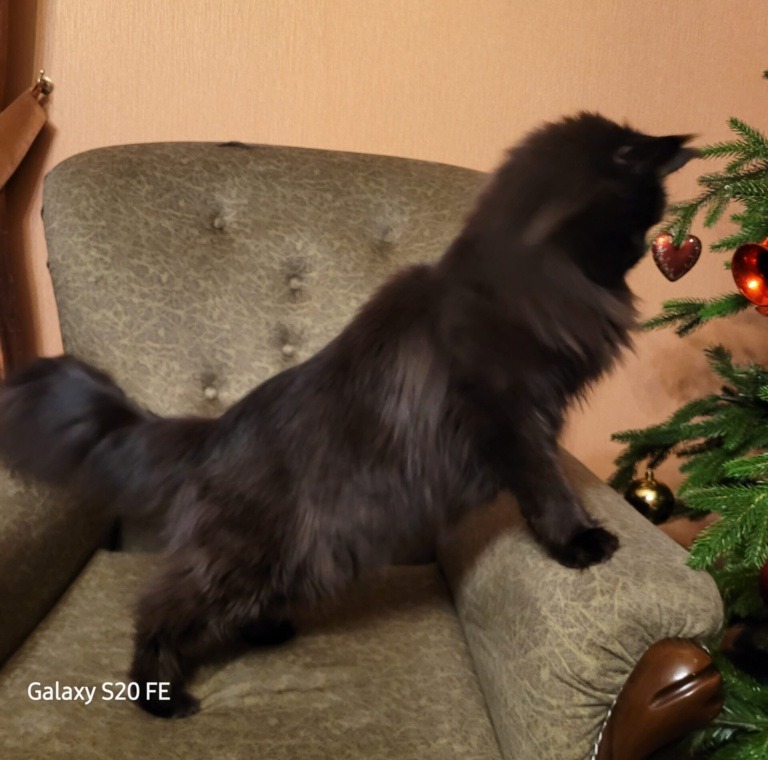
Ears are the first thing a judge looks at and the first thing a buyer asks about. "Will he have tufts?" We hear that question every time people come to see our kittens.
The ear should be large, big in relation to the head, and a Coon's head is far from small to begin with. Wide at the base, tapering gradually towards the tip. The tip is pointed.
The ears are set high and almost upright. The gap between them is about one ear's width: if two would fit, they're set too wide, and that's a noticeable fault.
Inside grow the furnishings, long hairs that extend beyond the edge of the ear. The standard requires them, and a judge will note it if they're missing. The tips may carry tufts, and they're why the breed gets compared with the lynx.
Tufts are not compulsory. They can be long, barely visible or missing altogether, and none of this affects breed quality in any way.
Kittens often have none at all: the tufts grow in by the age of a year to eighteen months, along with the ruff and the "trousers".
And the other way round: ordinary non-pedigree cats can have tufts. As a sign of the breed they don't work either way: they can neither prove nor disprove that a cat is a Coon. The furnishings inside the ear are more reliable in this respect: the breed almost always has them, and they show earlier than tufts.
Like the breed's other features, the ear is a legacy of Maine winters.
The furnishings protect the ear canal from snow, wind and debris, working as a filter. The tufts, according to a popular theory, help pick up air movement and pinpoint where a sound is coming from, rather like whiskers, only for hearing. A large ear with a wide base has more surface to collect sound, which is useful for a mouse hunter in a dark hayloft.
These explanations are hard to test rigorously, but at least they fit with the way the breed developed.
A healthy cat's ear hardly needs cleaning. It cleans itself, and interfering more often does harm than good.
Check once a week, when you comb the cat. Fold the ear back and look inside. Normally the skin is pale and pinkish with no smell, and there's little or almost no wax.
Clean only as needed, usually every two to four weeks or less often. Use a cotton pad or gauze moistened with a special ear cleaner. Wipe only the visible part of the ear and the entrance to the ear canal.
What not to do. Don't push a cotton bud deep inside: it packs the wax down towards the eardrum instead of removing it. Don't pour hydrogen peroxide or alcohol-based solutions into the ear: they dry out and irritate the skin. Don't clean a healthy ear every day "just in case": constant interference makes it produce more wax.
The hair on the ear tips never needs trimming. Tufts and furnishings are part of the breed's look, and before a show people try to grow them, not cut them.
Normal: a little light brown wax, no smell, and the cat doesn't scratch his ears.
Looks like ear mites: dark brown or almost black crumbly deposits that look like coffee grounds. The cat keeps scratching his ears with a hind paw, shakes his head and tilts it to one side. There's an unpleasant smell. Ear mites spread to other cats in the house.
Looks like inflammation: redness, swelling, moist discharge, pain when touched; the cat won't let you touch the ear.
In either case, first write to the breeder you got the kitten from, especially if the kitten has only just arrived: they know what went on in the litter, what it was treated with and whether the littermates had anything similar. Some questions can be settled with a few messages and a photo of the ear.
If things are still unclear after that, or there's discharge, a smell or pain, go to the vet. Ear mites and ear infections (otitis) are treated with different medicines, and using "cure-all" drops blindly can make matters worse.
This is worth knowing when you choose a kitten. The W gene, which gives a solid white coat, also affects the inner ear: some white cats are born deaf, and the risk is higher in cats with blue eyes.
Hearing is checked with a BAER test, which gives a result for each ear separately. If you're getting a white kitten, ask the breeder for the test result: you can't detect deafness in one ear just by watching the kitten or making noises. None of this applies to patterned colours or white markings.
Ear care is one of those rare cases where less is more. Most of the problems people bring to the clinic start not with dirt but with over-zealous cleaning with cotton buds. A look once a week is all it takes.
You can see what adult cats' ears look like on the Females and Males pages. The breed standard is explained in By WCF rules (in Russian).
Home in Raksi Maine Coon cattery, St Petersburg. Our kittens are on the Kittens page, and care tips are in our VK group (in Russian).
 Mats in a Maine Coon's coat: why they form, how to remove them and what to comb with16 October 2026
 Maine Coon grooming: coat, claws, ears and paws26 September 2026
 Maine Coon shedding: 5 myths and 7 reasons it suddenly gets worse9 September 2026