
The biggest, the boldest, ready to leave today, a rare colour and a perfect pedigree. Five reasons to celebrate that a breeder reads as reasons to be careful.
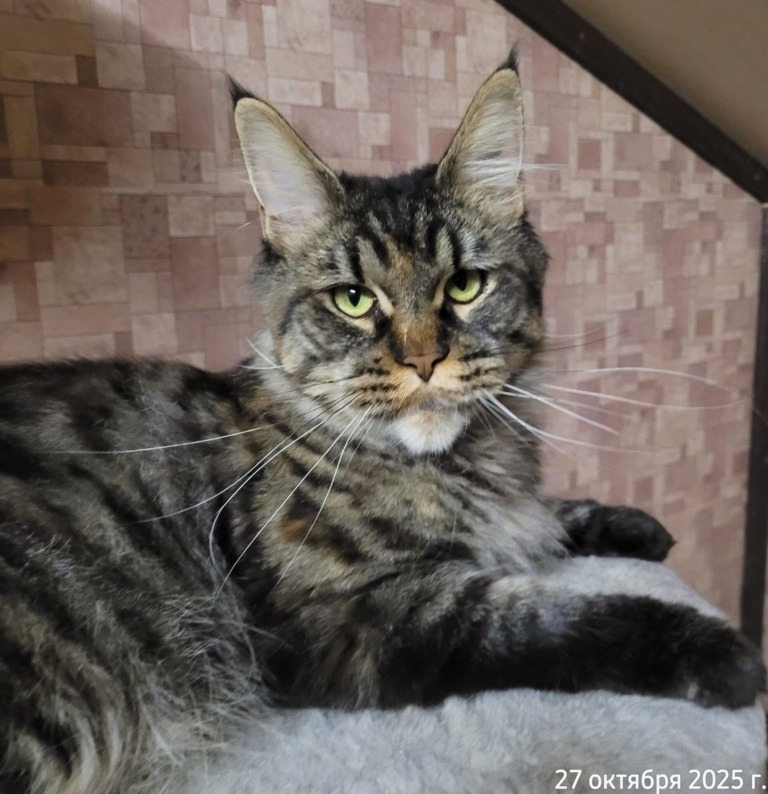
Buyers come to see kittens with a ready-made list of what they think are good signs. A breeder looks at the same things and sees something else. Here are five of those differences and what lies behind them.
How it looks to the buyer. There he is, the future giant. He's already bigger than the rest, so he'll grow up huge.
What the breeder sees. Nothing special. Kittens are born at different weights and grow unevenly: early on, the difference comes from their position in the womb and access to milk, not from genetics. By a year old it has mostly evened out. A cat reaches his final size at three to four years, so predicting adult size from a three-month-old kitten is guesswork.
What should worry you is something else. If a seller's ad leans on kilograms and weight, either they don't understand what they're selling, or they understand there's nothing else to show the buyer. A breeder talks about bloodline, ancestry and type.
What to look at instead. The parents, in person or in photos of them as adults. Size is inherited through the bloodline, not the litter.
How it looks to the buyer. Lively, brave, first to run over and say hello. Clearly healthy and clearly a leader.
What the breeder sees. A future cat who'll be racing across your head at four in the morning.
The most active kitten in the litter isn't the best one. That's just his temperament. He'll suit an active family without small children, and won't suit someone who works from home or lives a quiet life.
The opposite extreme is more worrying: a kitten who doesn't come out at all in an hour, presses himself into a corner when you try to pick him up, or sits motionless while the others charge about. That's no longer temperament but a reason to ask questions.
What to look at instead. Ask the breeder straight out what each kitten is like. The breeder has lived with the litter for three months and knows who climbs into your arms, who goes off to sleep alone and who's first to the food bowl. That's more reliable than an hour of watching. Most families are best suited by a calm kitten from the middle of the pack, not the leader and not the shy one.
How it looks to the buyer. Convenient. No need to wait another month and a half: the kitten eats on his own and uses the litter box.
What the breeder sees. A red flag. You can end the conversation right there.
The vaccination schedule goes like this: the first vaccination at eight to nine weeks, a booster three to four weeks later, then about two more weeks for the body to build protection. Before twelve to thirteen weeks a kitten simply isn't protected, and by the time he reaches a new home his mother's antibodies are gone.
The other half is behaviour. Until three months a kitten is brought up by his mother and littermates: where the litter box is and how hard you can bite in play. Bite too hard and the others stop playing with you. A kitten taken from the litter at two months has missed that course, and a year later the owners wonder why their cat bites their hands in earnest.
What to look at instead. The normal age to move is twelve to fourteen weeks, with two vaccinations, a vet passport with the vaccine stickers and the registration card in hand. Willingness to let a kitten go earlier is about the seller's convenience, not yours.
How it looks to the buyer. Exclusive. Nobody else will have one like it.
What the breeder sees. It depends on which colour they named.
The breed simply doesn't carry chocolate, lilac, cinnamon, fawn or colourpoint with blue eyes. If one of them turns up, a cat of another breed was in the pedigree. So behind a "rare chocolate Maine Coon" there's a seller who either doesn't know the subject or knows it far too well.
Real rarity looks duller: clean silver with no yellow tinge, or a neat van pattern. These colours are hard to breed, but they're allowed in the breed. And breeders don't usually charge extra for them; you just have to wait longer for a kitten like that.
A premium for polydactyly falls into the same category. Extra toes were historically normal in Maine Coons, in up to a third of the population, and became rare only because they were bred out. The rarity is artificial and says nothing about the quality of the cat.
What to look at instead. Open the registration card and read the colour code: it takes a minute to decode and tells you more than a fancy word in an ad.
How it looks to the buyer. A strong cattery, an excellent litter, what luck.
What the breeder sees. Someone who either can't assess cats or doesn't want to.
There's no such thing as a perfect kitten. In any litter one has a slightly short tail, another has ears that aren't set quite right, another has a white spot where his colour says there shouldn't be one. That's exactly what pet class is for: cats with minor deviations from the standard that make no difference at all to health, character or looks.
An honest breeder points out the faults before you find them and explains why a kitten is pet class. That isn't a weakness in the cattery. It shows the breeder understands what they are raising.
Show class comes with a caveat too: at three months it's about potential, not guaranteed titles. Contracts say exactly that: breeding quality is assessed by the breeder at the time of sale.
What to look at instead. Ask straight out what faults this kitten has. "None" is a worse answer than any fault on that list.
This sign comes from the other side, but it's the most telling of all. A good breeder questions the buyer: are there other pets, small children, will the cat be alone all day, are there safety screens on the windows, who will do the combing. Sometimes the breeder says no.
Someone who cares where the kitten goes cares about it before the sale, not after. A seller willing to hand a kitten to anyone who transfers the money is telling you quite a lot about themselves.
Each of these signs describes the seller, not the kitten. Big, bold, ready to go, a rare colour and show class, of course: that's a set of answers to what the buyer wants to hear. A breeder answers questions rather than expectations, and it sounds duller.
How to assess a kitten hands-on and which documents he should come with are covered in separate articles. Kitten classes are explained in Kitten classes.
Home in Raksi Maine Coon cattery, St Petersburg. Our kittens are on the Kittens page, and questions are welcome in our VK group (in Russian).
 Waiting list for a litter: how waiting for a Maine Coon kitten works23 October 2026
 Reserving a Maine Coon kitten: how the deposit works and what to put in writing22 October 2026