
Why a DNA test isn't enough, how it differs from a heart scan, how to read N/HCM, and what to do if your cat turns out to be a carrier.
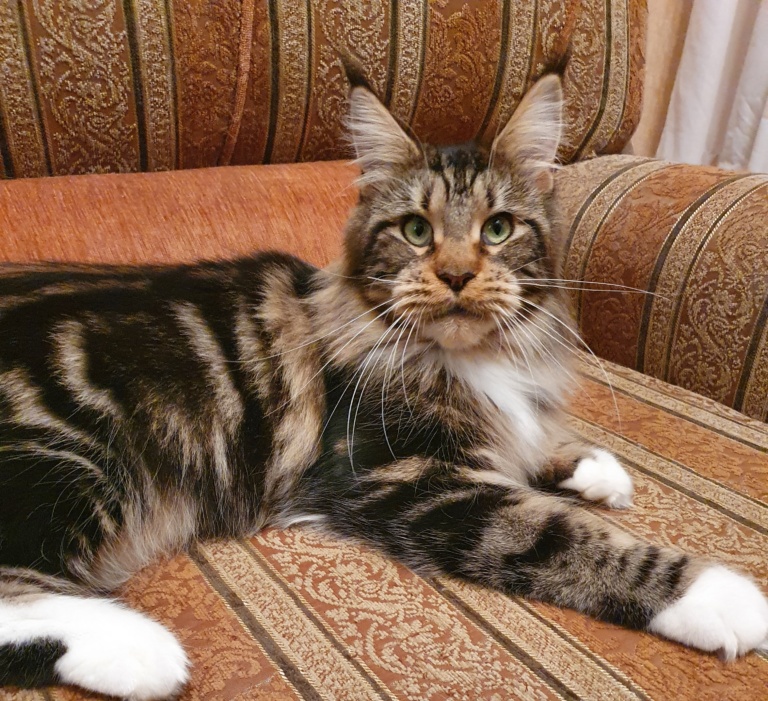
Three letters that appear in every Maine Coon advert and that few buyers can decode.
Yet this is the breed's biggest health question, and it's worth understanding before you buy, not after.
Hypertrophic cardiomyopathy is a thickening of the wall of the heart's left ventricle. The muscle gets thicker, the chamber inside gets smaller, and the heart can no longer fill with blood properly between beats.
It still contracts perfectly well, so for a long time everything looks fine. The body compensates, the cat lives a normal life and the owner notices nothing.
The problem is how it ends. Blood pools in the enlarged atrium and clots form. A clot that breaks loose most often lodges where the aorta divides and cuts off the blood supply to the hind legs. This is a thromboembolism, a serious and extremely painful condition. The other scenario is fluid on the lungs (pulmonary oedema).
In some cats, one of these complications is the very first sign of the disease. That's why so much attention goes on prevention here and so little on treatment.
The disease occurs in many breeds and in non-pedigree cats too. In Maine Coons it has been studied more than in others, because this is the breed in which a specific mutation was found.
In Maine Coons, a mutation in the MyBPC3 gene has been described and linked to HCM. The test uses a cheek swab or a blood sample, and the result comes back in one to two weeks. There are three possible results.
N/N: the cat is clear of this mutation, and both copies of the gene are normal.
N/HCM: a heterozygous carrier. One copy of the gene carries the mutation. Such a cat may live its whole life without any signs of disease, but it passes the mutation on to about half of its offspring.
HCM/HCM: both copies carry the mutation. The risk of developing the disease, and of it appearing early, is considerably higher.
Carriers aren't necessarily excluded from breeding altogether, but they are mated strictly with a clear partner so that no homozygous kittens are born. Dropping every carrier would narrow the breed's gene pool more than is justified.
This is the part the adverts leave out.
The known mutation doesn't account for every case. There is a form that isn't linked to MyBPC3: the cat tests N/N and still develops cardiomyopathy. Less often, but it happens.
Hence the rule serious catteries stick to: the DNA test is done once in a lifetime, the heart scan every year.
An ultrasound of the heart, an echocardiogram, shows the heart's actual condition: wall thickness, chamber size, how the valves are working. It detects the disease itself, not a predisposition to it.
It takes about twenty minutes and needs no anaesthetic: the cat is simply held on its side. It should be done by a cardiology specialist, because a routine abdominal ultrasound doesn't look at the heart in this way.
Three questions weed out most of the dubious offers.
Can I see the DNA tests for both parents? A laboratory report with a number, the cat's name and a date. Not a story, not a screenshot of a chat, not "ours are all clear".
Can I see the parents' latest heart scan reports? They should be yearly. A test from ten years ago for a breeding cat that's still alive means nobody has looked at its heart since.
What will you do if the kitten is diagnosed with HCM? The answer should be in the contract, not in a verbal promise.
The line "we haven't tested, none of ours has ever been ill" means just one thing: nobody has watched the cats for long enough. The disease most often shows up after the age of three, and kittens are sold from queens aged two or three.
Our breeding cats are tested, they have a heart scan every year, and the results are on each cat's page: you can look them up before your visit without having to ask.
First, stay calm: being a carrier and having the disease are not the same thing.
For a neutered pet, an N/HCM result only means that he won't be used for breeding. It means nothing more: the cat can live a full life without a single symptom.
If the scan shows changes, that is a diagnosis, and from then on it's a job for a cardiologist. The disease can't be reversed, but there is treatment that slows it down and lowers the risk of clots. Many cats with confirmed HCM live for years on maintenance medication.
Here's what to do. First, write to the breeder you got the kitten from: they know the line and what the parents and littermates have had, and the vet will need that information. Then go to the cardiologist with the cat's history rather than a blank page.
After that it's a routine: follow-up scans on the schedule the vet sets, no excess weight, and no experimenting with medication on your own.
There are almost no early signs, but there are a few things you can notice.
Breathlessness after ordinary play, breathing with the mouth open, breathing with the belly at rest. Less stamina: the cat no longer jumps up to places he used to. Sudden loss of use of the hind legs with crying out is an emergency: get him to a vet straight away.
A useful habit: once a month, count your cat's breathing rate while he's asleep. Normal is up to about thirty breaths a minute. If it stays higher than that, see the vet.
A breeder can't promise that a cat will never get ill. Nobody can. But they can show that they've done everything that can be checked: DNA tests on both parents, recent heart scans, pairs chosen with the results in mind. The difference between that and a private ad isn't measured in money but in whether you know anything about the hearts of your cat's ancestors. So ask the breeder for both documents, the DNA test and a recent heart scan, for both parents.
Our breeding cats' tests and heart scans are published on the Females, Males and Veterans pages. Maine Coon kittens are on the Kittens page.
Home in Raksi Maine Coon cattery, St Petersburg. Ask your questions about the health of our lines in our VK group (in Russian).
 5 Maine Coon myths that make owners ruin their cats' health24 October 2026
 Allergic to Maine Coons? Whether hypoallergenic cats exist and how to test your reaction14 October 2026