
What happens to a kitten from birth to three years, what it weighs at each age, when the teeth and eyes change, and the point at which owners usually start worrying for no reason.
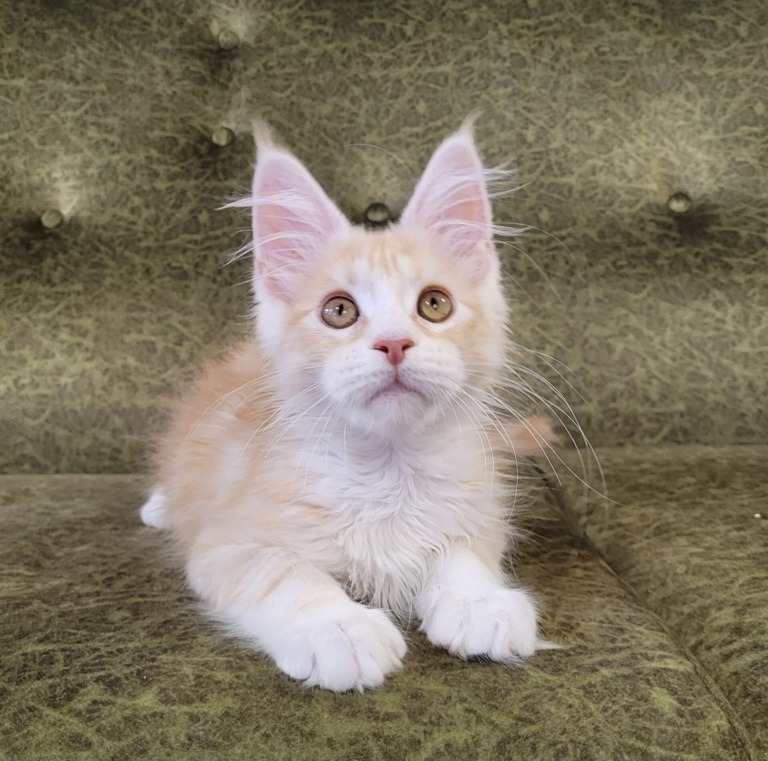
You choose a kitten from a photo at two months and then live with a cat who looks completely different. There are about three years between those two points, and almost every month something changes: in the body, in behaviour, in the things that make you want to worry for no reason.
A kitten weighs 100 to 170 grams, is blind and deaf, and does nothing but sleep and feed. The eyes open between day seven and day fourteen, and every kitten's eyes are blue, whatever colour they will turn later.
It gains 10–15 grams a day. At this age that gain, not size, is the main sign that all is well.
Weight 250–450 grams. The kitten gets up on its feet and starts to walk, and the milk teeth come through. Its hearing opens up and it starts reacting to sounds.
This is also when socialisation begins: the breeder picks the kittens up and gets them used to human smells and household sounds. What happens in these weeks shapes the adult cat's character more than any later training.
Weight 550–740 grams. The kitten tries solid food, learns to use the litter box and starts playing with its littermates. Play at this stage isn't entertainment but learning: this is how it finds out how hard it can bite.
Weight 1.1–1.6 kg. The kitten is fully weaned, races around and is already showing its character. The first vaccination is given at this age, usually at 8–9 weeks.
This is also when you see the kind of ad you need to learn to recognise: "ready to go at two months, already eating on his own". Eating on his own proves nothing. The kitten doesn't yet have the immunity that comes from a full course of vaccinations, and he hasn't finished learning from his mother and littermates.
Weight 1.7–2.5 kg. The booster has been given, and about two weeks have passed for immunity to build. The kitten feeds itself, uses the litter box confidently and knows the rules of play.
This is the normal age to move to a new home: twelve to fourteen weeks. The kitten leaves with its kitten card (birth registration), a vet passport with the vaccine stickers, a tattoo or microchip, and a contract.
At three months you can already see the big paws, ears that are wide at the base and a body that is long for the kitten's height. Ear tufts, on the other hand, are often missing altogether, and that's normal.
Weight 2.8–4.5 kg. The teeth change: the milk teeth fall out and the permanent ones grow in. Sometimes an owner finds a tooth on the floor, but more often the kitten simply swallows them, and that's nothing to worry about. The final eye colour also settles in this period: by four months you can usually tell what it will be.
This is also when the first gangly stage begins: the kitten stretches out and gets leggy, and owners regularly write to tell us their cat looks "a bit thin". As a rule, it's just normal growth.
Weight 4–6 kg. Adolescence, with everything that comes with it: the cat tests boundaries, gets into places he shouldn't and, if he's an unneutered male, may start spraying.
This is the age when neutering or spaying is discussed for pets. Check the timing with the breeder you got the kitten from: they know the line and how its relatives coped with anaesthesia. After that conversation, see a vet to set a date and find out how to prepare.
Males 5.5–7 kg, females 4–5. Still a teenager to look at: long and gangly, with paws and ears he has yet to grow into. The ear tufts start to grow and the first ruff appears.
Males reach 6.5–8 kg, females 4.5–6. Muscle builds up, the chest broadens, the bones get heavier, and the cat stops looking like a teenager. The coat reaches its adult level: the ruff is prominent in winter and almost disappears in summer, and the britches grow longer.
Full adult size, in some males not until four. Adult weight: males 6–9 kg, females 4–6.5 kg.
Behaviour, on the other hand, never quite grows up. A three-year-old Maine Coon still chases a sweet wrapper down the hall and skids round the corners. That's the breed, not a developmental delay.
All the weights above are breed averages, and the spread within a litter can be wide. A kitten can track the lower end and grow into a big cat, and vice versa. Size at three months says almost nothing about adult weight: the early difference between littermates evens out by a year.
Look at the trend, not the absolute number: the kitten should gain steadily. Growth stopping or weight loss is a reason to act. First write to the breeder: they can see how the littermates are growing and compare. If the question is still open after that, then see a vet.
On the outside, the first year is all about size and coat. But the most important part happened earlier, unnoticed: those few weeks when the kitten learned from its mother and littermates how to behave with other living beings. That stage can't be made up later.
You can see how our kittens grow up in the photos in our Graduates section (in Russian), and current litters are on the Kittens page. A detailed growth chart is covered separately in the Maine Coon growth chart.
Home in Raksi Maine Coon cattery, St Petersburg. We post kitten photos every week in our VK group (in Russian).
 7 Maine Coon care mistakes that seem harmless23 October 2026
 What to buy before your Maine Coon kitten arrives: a no-nonsense list18 October 2026
 Litter box and litter for a Maine Coon: what size you need and what to do if the cat misses11 October 2026