
How letting a cat roam differs from a walk on a harness, why indoor cats live longer than outdoor ones, how to get a Coon used to a harness, and what to do about your windows before the kitten arrives.
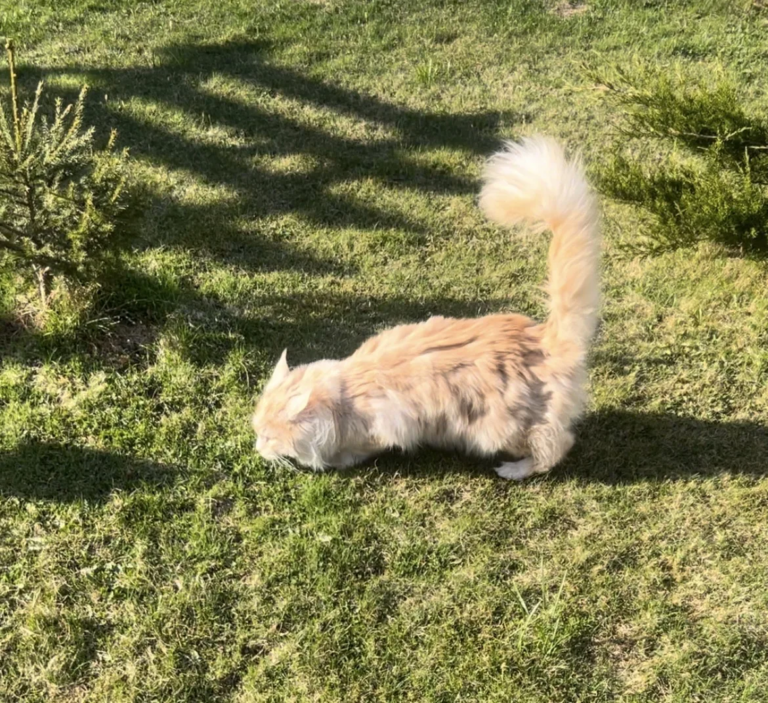
A big, lynx-like cat asks to go out on the balcony and sits at the window for ages. The owner decides the cat is missing nature and buys a harness. But a walk on a harness and letting a cat roam are completely different things, and the most important part of this subject isn't about the outdoors at all. It's about windows.
On average, a cat who is let out on his own has a noticeably shorter life than an indoor cat. The reasons are dull and well known.
Cars. Dogs. Other cats and fight injuries, and with them infections, including incurable ones. Ticks and fleas. Poisoning, accidental and deliberate. Basements, building sites, manholes. And people: a pedigree cat outdoors attracts attention, and a Maine Coon can be spotted from a long way off and is trusting, which works against him outside.
A cattery contract usually forbids letting the cat roam outright. That's not a formality: the condition is based on experience.
The argument "but he's bored shut up indoors" falls apart on a simple fact: boredom is solved with height, toys and human attention, not with the risk of being hit by a car.
Physically, a cat doesn't need walks. For a dog, walks are tied to the toilet and to the need to explore territory. For a cat, they aren't. An indoor cat with play, height and a person nearby lives a full life and doesn't suffer from missing the outdoors.
What's more, for many cats going outside is stressful rather than fun. Strange smells, sounds, movement, nowhere to hide. The cat presses himself to the ground, looks for somewhere to hide and longs to get back into the carrier.
Walks make sense in three cases: the cat genuinely enjoys them and stays relaxed; you live in a house and want to build a safe outdoor enclosure; or you need to get the cat used to the carrier and travelling, and walks are part of that work.
If the cat is tense outside and wants to go home, don't insist. You don't have to walk him.
A harness, not a collar. A cat pulls a collar off over his head in a minute, and if you try to hold him back it presses on his throat. A Coon needs a vest-style or figure-of-eight harness with wide straps, in the right size: you should be able to slide two fingers between the harness and his body.
At home, not outside. First just leave the harness in the room so the cat can sniff it. Then put it on for a minute and take it off straight away, with a treat. Gradually build up to half an hour. Almost every cat reacts the same way at first: he flops onto his side and refuses to walk. That's normal. Wait it out and don't drag him by the lead.
Then the lead, also at home. Let it trail behind the cat, then pick it up and simply follow him without steering. You don't lead a cat, you follow one.
Only then outside. For the first outing, carry him in the carrier to a quiet place with no dogs or people: a courtyard, a country cottage, a wood. Open the carrier and let him come out on his own. Don't tip him out.
It all takes a few weeks. An adult cat who has never been outside is harder to train than an adolescent.
Don't go out without these.
A full course of vaccinations, and flea and tick treatment with a product that matches his weight. A Maine Coon is big, and doses for an average cat are too small for him, so check.
A microchip or a tattoo, and ideally an ID tag on the harness as well. A lost cat with no identification rarely makes it home.
Neutering or spaying. An entire cat behaves differently outside and is more likely to run off.
And the place: a quiet courtyard, a country cottage, a wood. Not a busy street, not a park full of dogs, not a playground. After a walk, check the cat for ticks, especially behind the ears, on the neck and in the groin.
This is where the fun ends and safety begins.
A mosquito screen won't hold a cat. It falls out of the frame with him. A nine-kilo cat knocks it out without any effort, and with a big animal this happens even more reliably than with a small one.
You need cat-proof screens: a metal frame, strong mesh, a secure fixing to the window frame. This isn't overcaution or advertising: vet clinics see a lot of these patients, especially in spring.
Cats don't always land on their feet, and a fall from a height causes a typical set of injuries: a broken jaw, a split palate, damage to the lungs and legs. Even from two floors up.
A balcony must be glazed, with the gaps closed off. For a cat, an open balcony isn't an outing. It's a matter of time.
The tilt setting on a tilt-and-turn window is a trap of its own: the cat climbs into the gap, slides down and gets stuck, and the frame squeezes him tighter the more he struggles. There are special guards that close off this gap.
Everything a cat supposedly goes outside for can be recreated in a flat.
Height: shelves, a cat tree, a spot on top of the wardrobe. For a big cat this matters more than floor space. A view from a window with a safe screen works as cat TV, and cats spend hours in front of it.
Hunting: wand toys and teasers, and play until he's tired, not five minutes in passing. A Coon is focused on people, and playing together means more to him than any toy. Puzzle feeders, where he has to work for his food, also suit this clever breed well.
A pot of cat grass is a safe substitute for the outdoor greenery cats go onto lawns for.
The difference in life expectancy between an indoor cat and one that roams free is measured not in years but in multiples. It's the weightiest argument in the whole discussion, and also the dullest: here the right decision is also the convenient one. If you remember one thing from this article, let it be metal cat-proof screens on your windows instead of mosquito screens.
What else to buy before your kitten arrives is covered in a separate article. Our advice on keeping a Maine Coon is collected in the Care guide.
Home in Raksi Maine Coon cattery, St Petersburg. Our kittens are on the Kittens page, and you can send us questions in our VK group (in Russian).
 7 Maine Coon care mistakes that seem harmless23 October 2026
 What to buy before your Maine Coon kitten arrives: a no-nonsense list18 October 2026
 Litter box and litter for a Maine Coon: what size you need and what to do if the cat misses11 October 2026